By FEMM Staff
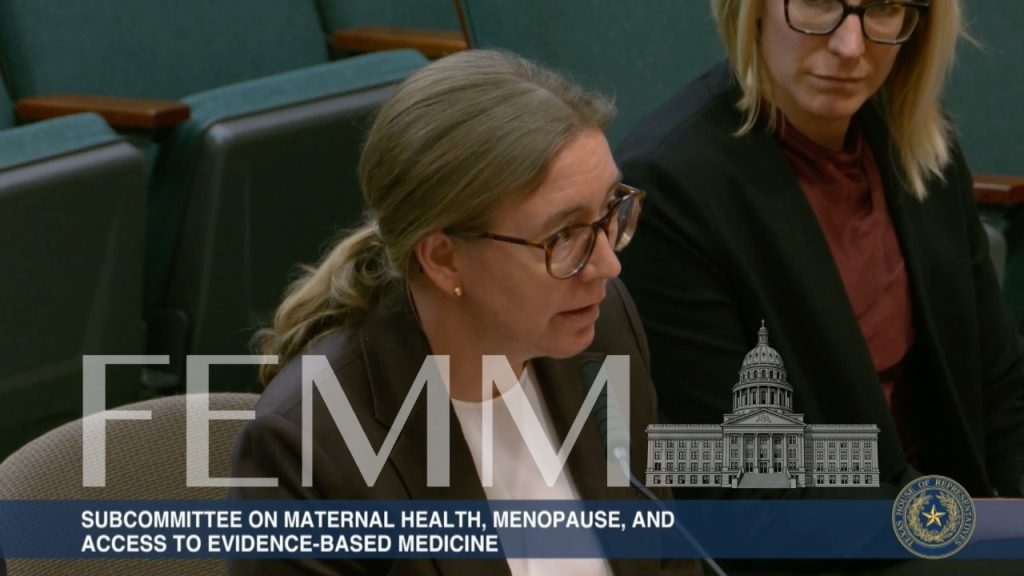
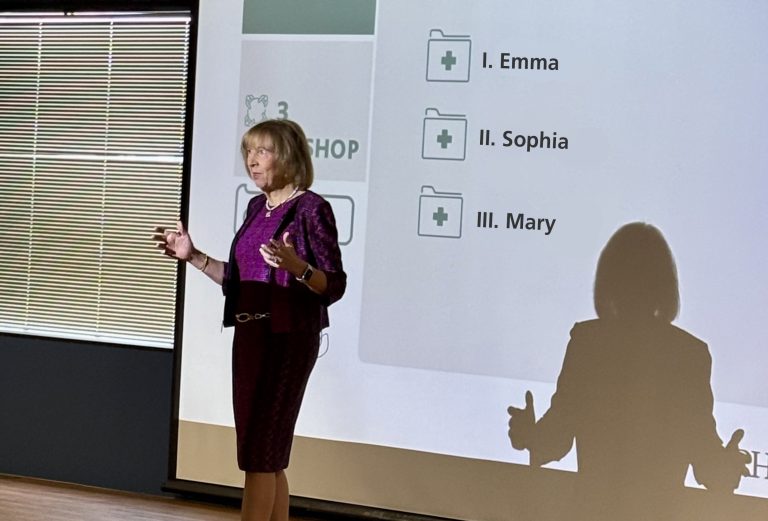
When FEMM CEO Anna Halpine spoke at the Texas House of Representatives to the Subcommittee on Maternal Health, Menopause and Access to Evidence-Based Medicine on October 5th, 2026, she began by telling the story of three women—at three different stages of life.
Emma, 15: Irregular, heavy periods, acne, increased body hair, and weight gain. She is told it’s normal for puberty and to wait and see if things normalize. A year later: severe anxiety, depression, anemia, and more weight gain.
Sophia, 32: Years of irregular cycles, monthly pain, mood changes, and exhaustion. She is told not to worry. A decade later: double vision and a pituitary tumor requiring brain surgery.
Mary, 50: Her cycles change, followed by insomnia, mood changes, and problems concentrating. She is told she’s being difficult and given an antidepressant. Five years later: a stroke impacts the use of her right hand.
Anna’s testimony highlights an all-too familiar approach to women’s health: wait and see. It’s a standard of care that frequently dismisses symptoms as a normal phase of puberty, stress, something that pregnancy will sort out, or simply old age. Each of these three women: Emma, Sophia and Mary presented with clear warning signs and symptoms. At each phase of a woman’s life, the signs and symptoms of a hormonal disorder were normalized. Each one was failed by the medical system in being told to “wait and see”.
How Many Decades Do Women Have to Wait?
In 1993, at a conference in Malta, some of the world’s leading reproductive endocrinologists met to settle a question: when a woman presents with menstrual disorders, do you treat her, or do you wait it out?
A team from the University of Texas pressed the question: one Dr. Emil Steinberger refused to let the room dismiss these women as too young or too old. Again, and again, he insisted that symptoms should be taken seriously and treated. With him, Dr. Keith Smith and Dr. Luis Rodriguez-Rigau affirmed the same conviction: the goal should not be to numb a woman’s symptoms, but to find out what is actually wrong and address the underlying cause.
In the middle of that debate, a young Chilean physician—Dr. María del Pilar Vigil, an MD working toward her PhD in reproductive endocrinology under Dr. Steinberger at the University of Texas—stood up and asked the question no one could answer: What is the minimum hormonal work-up we owe a woman
A Basic Hormonal Profile
More than three decades later, the research and evidence is clear. Dr. María del Pilar Vigil, PhD, is now the lead researcher at the Reproductive Health Research Institute (RHRI). She has authored more than 220 scientific publications in indexed journals and books, and her research has accumulated more than 3,500 citations according to the 2026 AD Scientific Index.
RHRI serves as the official research, clinical protocol development, and medical training arm for FEMM. Dr. Vigil, alongside researchers and clinicians at RHRI have worked to translate decades of scientific knowledge into standardized clinical protocols. Ongoing research conducted by the RHRI, along with research collaboration and partnership across a wide range of countries and disciplines, continues to inform the evidence-based model for care offered through FEMM.
In a recent RHRI study of 251 girls and women with menstrual irregularities, the most common causes of irregularities were: sub-optimal thyroid function, hyperandrogenism, insulin resistance, and elevated prolactin.
Hormones Reach and Touch the Whole Person
This cannot be overstated: the consequences of untreated hormonal dysfunction are not confined to reproductive health. This is why FEMM refers to ovulation, not simply as an event of interest to achieving pregnancy during a woman’s reproductive years, but as a vital sign of a woman’s overall health. The ovulatory cycle is an intricate relationship between the brain and the reproductive system, requiring that over a dozen hormones rise to the correct levels at the right time, each cycle.
This is why one test on one random day tells us so little about a woman’s hormonal health.
For RHRI and FEMM, the minimum hormonal work-up we owe a woman, is called the “BHP” (Basic Hormonal Profile). It is a simple blood draw taken on day 3, 4, or 5 of a woman’s cycle, that measures more than a dozen hormones and other values that play a vital role in a woman’s metabolic, reproductive, mental and overall health.
From RHRI to FEMM Clinical Care
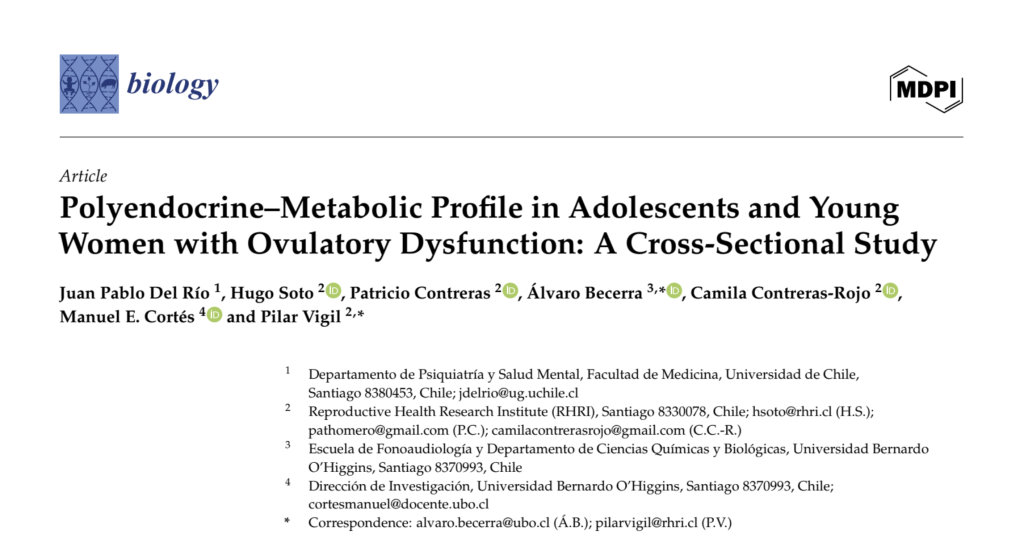
For patients like Emma, Sophia and Mary, every one of their later, chronic symptoms was written years earlier in labs that were never ordered. In a study of 117 adolescents and young women with ovulatory dysfunction, more than half carried clinically elevated depression scores; and the higher a girl’s testosterone, the deeper her depression. “In adolescence, hormones don’t just regulate the body – they wire the brain, laying down circuits during a window of plasticity that later closes. Get the hormones wrong then, and you are not treating a passing symptom; you are shaping how the brain will work for decades to come,” as Anna stated in her testimony.
This year, mainstream medicine caught up to the science in public: The Lancet, backed by fifty-six organizations, renamed PCOS (polycystic ovarian syndrome) to PMOS (polyendocrine metabolic ovarian syndrome), an admission, Anna highlighted, “that the disorder was never confined to the ovary. It never is. It reaches, and touches, the whole person.”
Untested and untreated hormonal disorders show up in the bones, the joints, and the brain.
In adolescence, untreated hormonal dysfunction looks like mental health issues, acne, insulin resistance and obesity; during reproductive years, hormonal dysfunction shows up as abnormal uterine bleeding and gestational diabetes; in menopause, hormonal disorders lead to neurodegenerative disorders, such as Alzheimer’s and Parkinson’s.
The Bottom Line
For FEMM, the goal is straightforward, if ambitious: bridge the gap between research and its routine integration into clinical protocols and make the best hormonal healthcare accessible to women at every stage of life, both in person and through telehealth. Together, RHRI and FEMM have the research, protocols and medical network capable of delivering a better standard of care to women.
Today, more than 300 U.S. medical professionals—including physicians, nurse practitioners, physician assistants, and midwives—have been trained in the FEMM protocols, with the model also being taught internationally. In Tanzania, for example, the FEMM protocols are incorporated into the model of care at Bugando Medical Centre in collaboration with Weill Cornell Medicine.
In 2024, FEMM medical providers at the Bugando Medical Center in Mwanza, Tanzania published new research in the European Journal of Preventative Medicine showcasing impressive results using FEMM protocols to help women with infertility. The research team recruited 230 women with hormonal infertility for their study. Over two-thirds of these patients were not ovulating. “After just three months of treatment, 85.2% of the women showed improvement in cervical mucus consistency; 93.9% had normal bleeding patterns; and one-third conceived.”
For decades, the initial response to patients has been to wait. With FEMM and RHRI, there is a different model of care: “Detecting a hormonal imbalance early is not only the cheaper path. It is the better path. It is the one that lets a woman stay herself—clear-minded, strong, and present—through every season she is given,” Anna affirmed
An Ounce of Prevention
For lawmakers at the Texas House of Representatives weighing rising healthcare costs, there is reason to pursue a new path: “PCOS, that one renamed condition alone, costs the United States more than fifteen billion dollars a year, nearly twice what we spend on ovarian cancer, with up to seventy percent of the women who have it never diagnosed; menopause care and the work it costs add some twenty-six billion more.”
But, Halpine stressed, the dollars are the smallest part of the loss: “The real cost is a woman’s own life: her work, family and child raising, and later, grandparenting, restricted in a body worn down at every level: metabolic, skeletal and cognitive, by something we could have caught and treated…”
The testimony of the FEMM CEO was clear and compelling: women should not have to wait and see if their health further deteriorates before a physician investigates the underlying causes. Luckily, the physician who challenged the prevailing thinking decades ago is as determined as ever to change the standard of care, today. Together, RHRI and FEMM continue their work, thanks to friends like Dr. Emil Steinberger, who helped to build the fledgling University of Texas Medical School at Houston as Chair of the Department of Reproductive Medicine and Reproductive Biology, and, with colleagues, established the Texas Institute of Reproductive Medicine and Endocrinology. He was a champion of diagnosing and treating the underlying conditions, in order to restore health in both men and women. RHRI and FEMM are honored to carry on the legacy, and make comprehensive hormonal health care accessible to everyone at every stage of life.
¹ Melnyk, Bernadette. (2021). The Current Research to Evidence‐Based Practice Time Gap Is Now 15 Instead of 17 Years: Urgent Action Is Needed. Worldviews on Evidence-Based Nursing. 18. 318-319. 10.1111/wvn.12546.