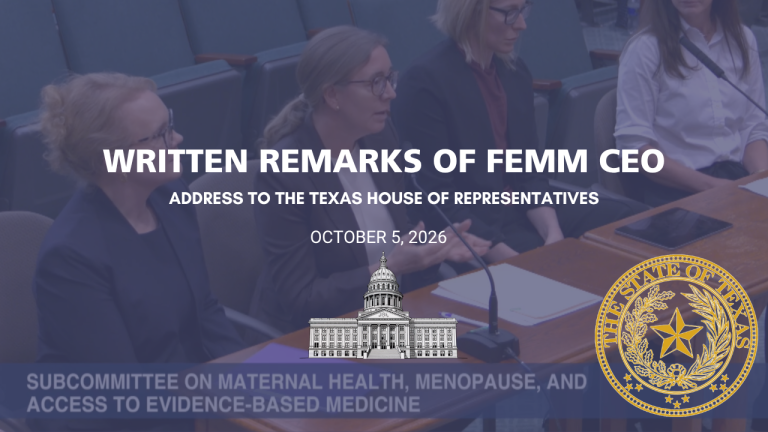
October 5, 2026
Anna Halpine, FEMM CEO
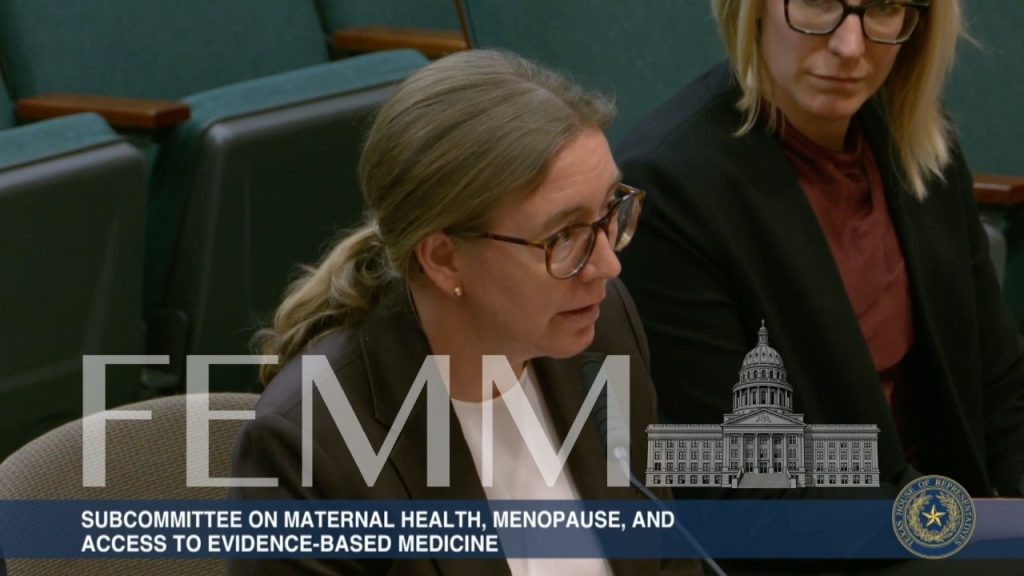
Remarks to the Subcommittee on Maternal Health, Menopause and Access to Evidence-Based Medicine
Hello, my name is Anna Halpine and I am the CEO of FEMM.
Rep Pierson, Chair of this subcommittee, Rep Campos, Rep Shofner: Thank you for inviting me to speak to you today.
Let me tell you about the women we serve.
Emma is fifteen. She has irregular cycles and heavy menstrual bleeding, associated with acne, body hair increase, and weight gain. Her physician told her this is normal during adolescence and that she should eat better and wait, and the hormones driving all of this were never once examined. One year later, Emma starts presenting with severe anxiety disorder, depression, anemia, and obesity.
Sophia is thirty two. Like her mother before her, her cycles were always irregular, and the week before each one brought its own storm of mood, pain, and exhaustion. She was told not to worry, that pregnancy would set things right, and no one ever thought to check her hormones. A decade later, she begins seeing double, and a tumor in her pituitary gland sends her into brain surgery.
Mary is fifty. Her cycles shorten and then stop. Her sleep, her mood, her focus all unravel, and everyone tells her she has simply become difficult. She is handed an antidepressant, while the estradiol, testosterone and progesterone her body has lost are never once considered. Five years later, a stroke takes the use of her right hand.
Three women. Three different ages. One thing in common: in every case, there was a single moment when a medical provider could have ordered a simple hormonal work-up, and instead these patients were told to wait. Emma, Sophia and Mary needed a hormonal profile. Each one sat waiting for a single blood draw that nobody ordered.
Today, this is the choice in front of us. Should we wait? Or should we check the hormone values of our women?
For most of the last century, up to and including today, medicine has chosen to wait. It’s her age. It’s stress. Come back when you want a baby.
In 1993, in a conference room in Malta, some of the world’s leading reproductive endocrinologists met to settle a question: when a woman presents with menstrual disorders, do you treat her, or do you wait it out? A team from the University of Texas pressed the question. Dr. Emil Steinberger refused to let the room dismiss these women as too young or too old; again and again, he insisted that their symptoms and disorders should be studied and treated. Beside him, Dr. Keith Smith and Dr. Luis Rodriguez-Rigau pressed the same conviction: the goal should not be to numb a woman’s symptoms, but to find out what is actually broken and fix it.
In the middle of that debate, a young Chilean physician — Dr. Pilar Vigil, then working toward her PhD in Houston alongside the UT team — stood up with the file of a real patient in her hands, and asked the question no one could answer: what is the minimum hormonal work-up we owe these woman? Do we test her or do we simply hope she improves over time?
Thirty-three years later, we have the research and evidence-base to clearly answer this question.
The experts in the room in Malta could not settle their debate because they had different answers to the key question: is hormonal balance in women a real, definable state? The answer is now clear: It is. But it is not a single number and that is exactly why one test on one random day tells us so little. We need to learn to look at patterns. And these pattens must be placed within the context of the changing stages of a woman’s life.
Dr. James Brown called this the ovarian continuum: hormonal balance shifts through intrauterine life, childhood, adolescence, reproductive age and menopause. And two of those stages carry a weight the others do not. Before birth and again in adolescence, hormones don’t just regulate the body – they wire the brain, laying down circuits during a window of plasticity that later closes. Get the hormones wrong then, and you are not treating a passing symptom; you are shaping how the brain will work for decades to come. Healthy looks different at every stage, but in these two stages, the stakes are permanent. Our group’s research has mapped that continuum in real women across ages and countries.
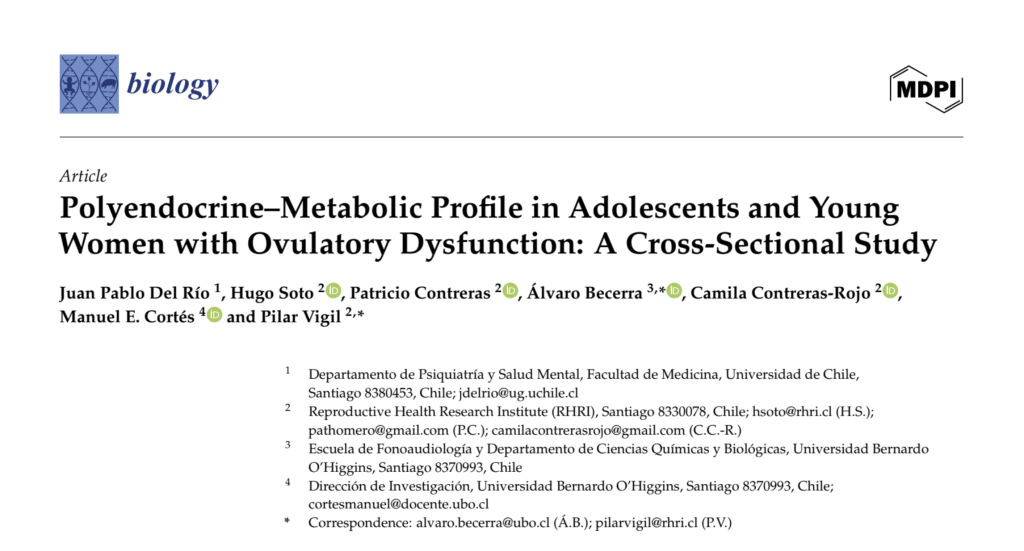
So what actually happens to Emma, to Sophia, to Mary when we wait, and leave them as they are? The body keeps the account, and it comes due over time. It comes due first in the mind: in one of our studies of 117 adolescents and young women with ovulatory dysfunction, more than half carried clinically elevated depression scores; and the higher a girl’s testosterone, the deeper her depression. It comes due in her metabolism: insulin resistance that begins in a slim young woman in adolescence, ends, decades later, in diabetes, in stroke. It comes due in the bones, the joints, and the brain — even in memory and thought. In every stage of life, women face specific risks, and specific threats. During pregnancy, gestational diabetes; in adolescence, mental health concerns and obesity; during reproductive years, abnormal uterine bleeding, and in menopause, neurodegenerative disorders, such as Alzheimer’s and Parkinson’s. Every one of these endings was written years earlier in a hormonal profile that was never ordered. Every one of these endings could have been different had the woman received early testing and treatment. For a state already facing a youth mental-health crisis, an unmeasured hormone is a clear unmeasured risk. Every year a woman’s hormones go unmeasured and untreated is a year her body and her mind quietly absorb the cost and pay for it later, when it is harder, and far more expensive and difficult, to treat.
This year, mainstream medicine caught up to the science in public: The Lancet, backed by fifty-six organizations, renamed polycystic ovarian syndrome to polyendocrine metabolic ovarian syndrome, an admission that the disorder was never confined to the ovary. It never is. It reaches, and touches, the whole person.
We believe a woman has the right to know whether her hormones are in balance for the season of life she is in. And, unlike that room in Malta, we now know exactly what to do. We built a hormonal profile, a framework, that reads the main hormonal axes simultaneously.
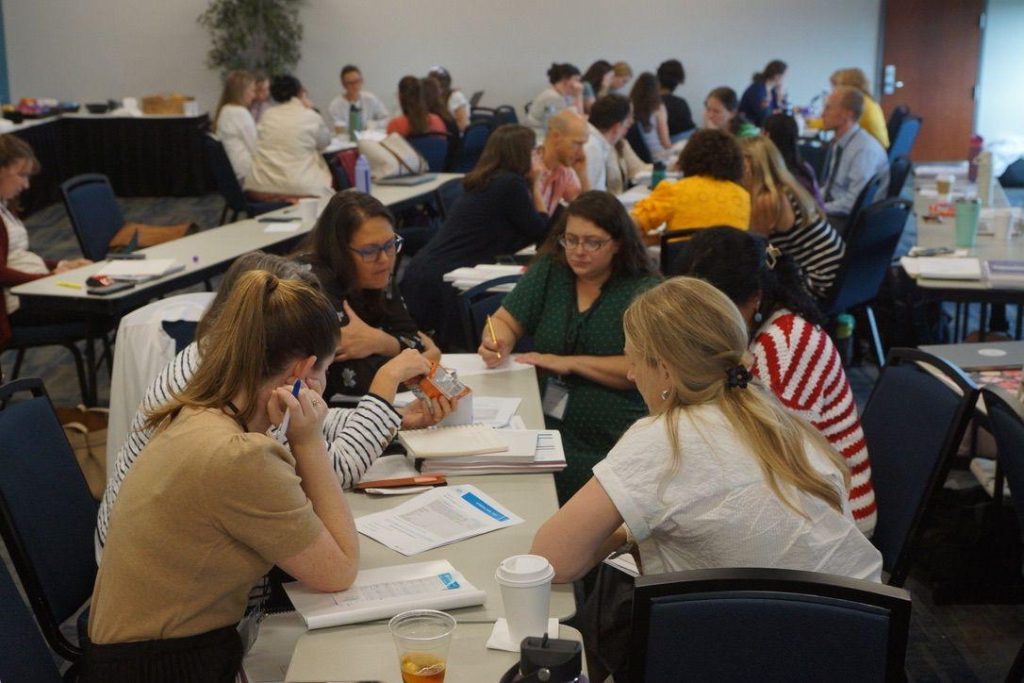
Through RHRI, founded in 2014, we turned decades of research and knowledge into standardized clinical protocols. FEMM is now building the network that delivers this medical care: physicians, nurse practitioners, physician assistants, and midwives trained in these protocols, are seeing women across the United States, in person and by telehealth, accepting most public and private insurance. Over 300 specialists have been trained in the United States alone, and these protocols are being taught to physicians around the world as we speak. We are making this care accessible, affordable and readily available to women across Texas, and throughout the United States.
Let me close with a word about cost. Leave these conditions undiagnosed, and when the bill arrives the cost is higher. PCOS, that one renamed condition alone, costs the United States more than fifteen billion dollars a year, nearly twice what we spend on ovarian cancer, with up to seventy percent of the women who have it never diagnosed; menopause care and the work it costs add some twenty-six billion more. But the dollars are the smallest part of the loss. The real cost is a woman’s own life: her work, family and child raising, and later, grandparenting, restricted in a body worn down at every level: metabolic, skeletal and cognitive, by something we could have caught and treated, with a simple test.
Detecting a hormonal imbalance early is not only the cheaper path. It is the better path; the one that lets a woman stay herself – clear-minded, strong, and present – through every season she is given. FEMM and RHRI have already built the science, the protocols, and the medical network to deliver exactly that, at every stage of a woman’s life.
The Texas physicians are the giants on whose shoulders we stand today. We can finally answer the question they raised thirty years ago: Yes, we should diagnose and treat the hormonal imbalances of our women. And today, now, we can.
Thank you.
Watch the full testimony: Watch Anna Halpine’s remarks here.