By Danielle Koestner, MD, et al
This poster was recently presented at the HHS National Conference on Women’s Health in Washington, DC. This study explored something that’s often overlooked in PCOS: not all cases are the same.
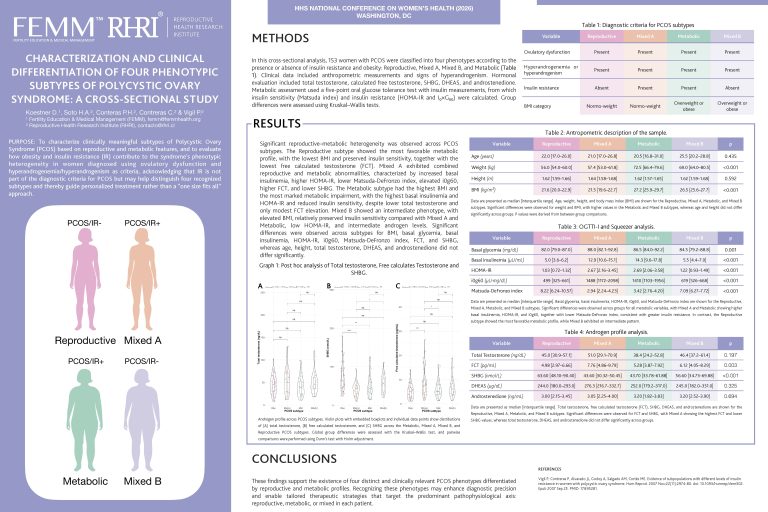
Instead of treating PCOS as a single condition, the researchers identified four distinct phenotypes, each with its own clinical and metabolic profile.
What this study highlights
The four subtypes — reproductive, metabolic, and two mixed phenotypes — show meaningful differences, especially when it comes to metabolic health.
Patients in the metabolic group tend to present with higher BMI, greater insulin resistance, and a more complex metabolic profile. On the other end, the reproductive phenotype shows a more favorable metabolic picture, with better insulin sensitivity.
The mixed groups fall somewhere in between, reinforcing that PCOS exists on a spectrum rather than as a single diagnosis.
Why this matters
Patient differentiation is key for effective diagnosis and treatment. When we recognize that PCOS isn’t one-size-fits-all, we can move toward more personalized and targeted treatment approaches — something that’s essential for long-term outcomes.