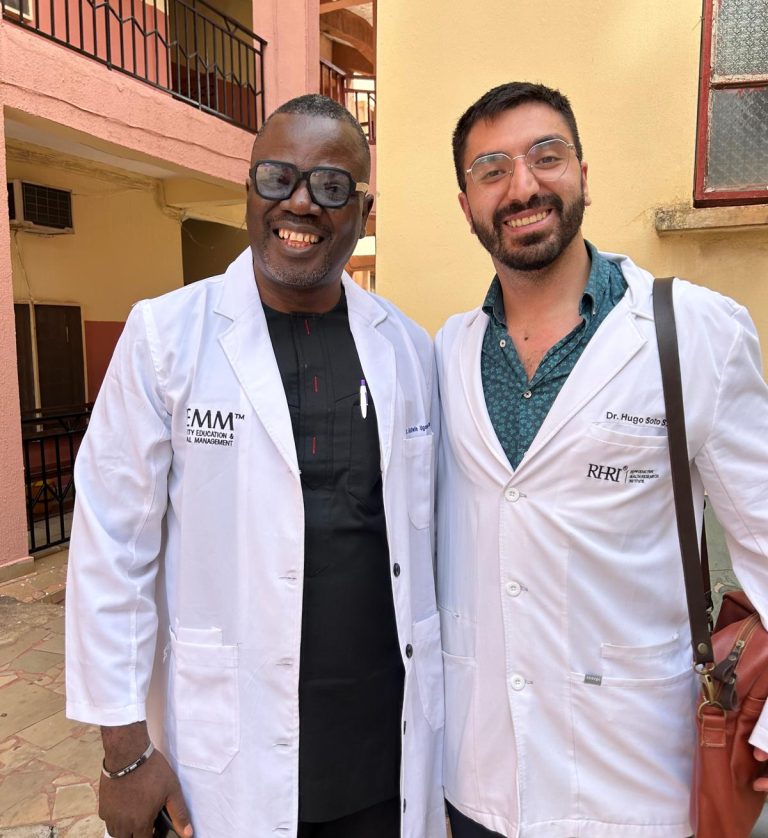
FEMM recently held its first-ever Medical Management Masterclass in Nigeria in partnership with medical doctors and leaders from across the country. Healthcare professionals gathered to pore over the research and FEMM treatment protocols together this month, learning how to meet their patients’ need for reproductive health education and treatment.
Following the growth of FEMM medical training in Tanzania (East Africa), FEMM has now partnered with doctors and local hospital leadership to bring our medical training directly to Nigeria and West Africa. While challenges in Nigeria contribute to the importance of hosting this training locally (security, financial challenges, and others), the opportunities are what drive the effort: Hospitals across the country ready to bring the FEMM medical protocols to the patients they serve, and to integrate the latest science and clinical approaches into their medical care.
Anna Halpine, FEMM CEO, highlighted the importance of investing in key medical doctors serving the most vulnerable across Nigeria and the region. “These medical providers are on the ground, serving the people in both urban and rural areas. It’s a privilege for us to share the knowledge and resources we have through FEMM and the Reproductive Health Research Institute (RHRI) to support their incredible work.”
Sr. Doctor Ignatia Okafor, a FEMM-trained doctor from Nigeria, spearheaded efforts to make the event happen locally. Thanks to her hard work and the efforts of many others, the first Nigeria Medical Masterclass quickly became a reality.
Dr. Hugo Soto, a researcher at the RHRI, led the event alongside Dr. Godfrey Kazilege and Dr. Onesmo Kasimba, both OB-GYNS and members of the FEMM medical team from the Weil Bugando Medical Center in Tanzania.
FEMM medical management protocols start with the foundation science of women’s health: namely, that ovulation is a sign of health. Armed with this knowledge, providers apply the science to advanced clinical care protocols for women along the entire reproductive spectrum, from puberty through childbearing years to menopause.
“The main goal was to teach that ovulation is not a simple mechanism that happens all the time,” Dr. Soto explained. “For a woman to ovulate, she needs to achieve a certain level of health—hormonal, metabolic, psychiatric. If we teach our patients to recognize their ovulation and when they’re not ovulating, it’s really helpful.”
He continued, “Not everyone recognizes that anovulation is a problem. Most women don’t know how to recognize their ovulation.” This lack of knowledge means that for many women, “their first appointment is when they have struggled with the disease for 15 years,” Dr. Soto explained. “These outcomes are not good.”
However, when patients understand the importance of ovulation and how to identify it using biomarkers, it becomes much easier to identify endocrine and metabolic disorders early, leading to better diagnosis and treatment options, for both health and fertility.
The ideal outcome, Dr. Soto said, is women who proactively monitor and take charge of their reproductive health from their teenage years onward. By noticing early warning signs, they can get the diagnosis and treatment they need as soon as possible, rather than suffering symptoms for years.
The FEMM masterclass teaches primarily through case studies. Participants were excited to discover that many of the cases applied to real-life patients they were seeing. Realizing that they could treat a woman’s underlying health problems rather than just her symptoms was eye-opening.
“People were amazed and excited,” said Dr. Soto. “By day three, everyone was saying, ‘I want more.’”
Physicians in Nigeria are off to an incredible start, tirelessly bringing what they’ve learned to the poorest and most vulnerable in their communities. FEMM is honored and grateful to walk alongside our colleagues in Nigeria as they provide the best in research and clinical protocols to every woman.